
Booooks 26
I am swamped in reading these two books simultaneusly...

Programming note: we are slowly approaching late term crunch, so please expect lower capacity in this amazing publication. I am late, but yet I arrive into your inbox with fresh content!
In the Meantime
I wasn’t following politics on either of the sides of the channel to fully cover any of the (FUN) events that shaped the day, and neither did I actually dive deep enough into any of the books I am currently reading to give you a (surely) desired review.
N. is here with her weekly Twitter (now X) report:
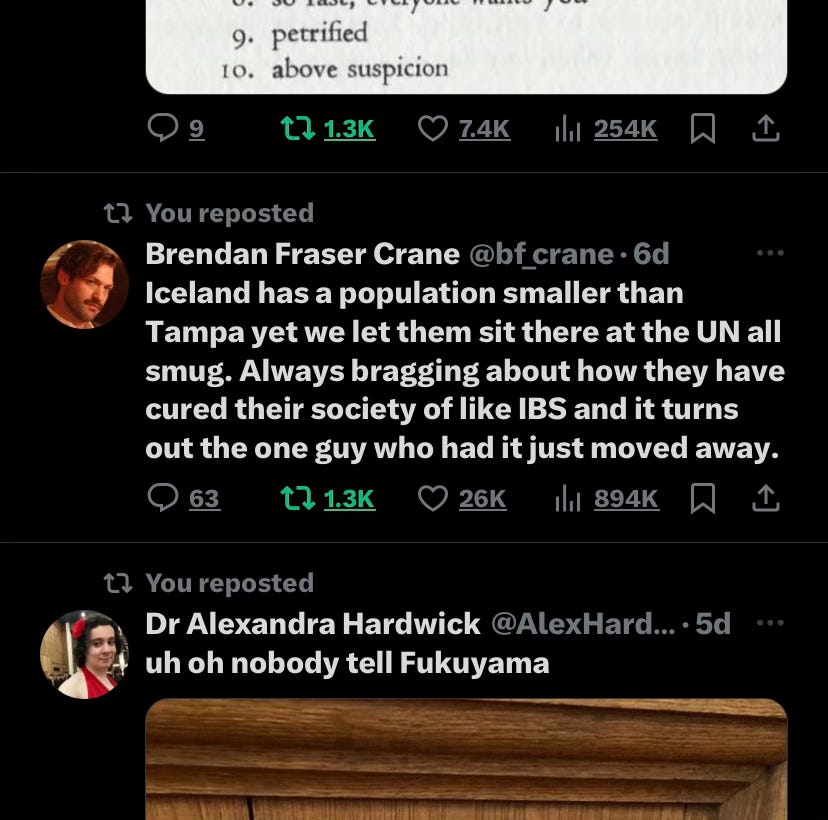
Please find these following ramblings at least a bit fun:
On the News
If ever in doubt, blame Derek Parfit.

So I was in Oxford the other day. Mostly to hang out with people (like T., O., K., B., J., and F.) but I also got the chance to spit on All Souls College and talk about Amia Srinivasan’s brilliance. Out of these events the most connected to the current AI (ah no not again) turmoil is of course All Souls College.
As you know I tend to have strong opinions about some people, especially those who graduated from the University of Oxford, England. Probably its mostly resentment, because their careers sometimes are mindblowing. But that must be because of the impeccable work ethic and sheer brilliance fostered in the sweet city with her dreaming spires.
There is one that hits me particularly hard. That of Derek Parfit. I read some of his works a few years back and was mostly confused (but that usually is the sign of brilliance in philosophy). I already wrote about Parfit’s general allure, now I turn to the ideologies he inspired.
On one hand, he came up with what is called the repugnant conclusion which argues, that because our policy choices determine in an indirect causal way who gets to be born, we have no obligation to change it to make lives better. This is the case because by changing policies we are not changing the lives of the same people. Additionally, this means, that we should just simply have as many children as possible because surely their lives, even if only barely worth living, are still better than a lack of them:
"For any possible population of at least ten billion people, all with a very high quality of life, there must be some much larger imaginable population whose existence, if other things are equal, would be better even though its members have lives that are barely worth living" (Parfit 1984).
I hate the assumptions the RC is stemming from, mostly the lack of realism about the future, trips to alternative realities and so on. Parfit himself was also disgusted by the responses it enacted. He hoped it would stir the debate and speed up the hunt for Theory X, which would resolve the RC.
Of course, if you do not accept the premise that utility can be quantified and that one should always aim to increase overall utility such a conclusion does not really bother your theory… right?
In Reasons and Persons parfit explores that theme deeper, not arriving at Theory X, but the quest is continued by other Oxford moral philosophers most notably William MacAskill (ah shit here we go again). Saint William claims that we owe our future no discounting. The future generations are just as important as people alive today. Henceforth we need and should stall the progress if need be to avoid existential risks, such as AI that would be able to kill all of us.
Over the weekend, there was a coup in the company that is at the forefront of developing such a programme (not really of course). OpenAI’s Sam Altman was fired for not being candid with the board. I have no idea why I needed to write this, but I just hate the way Parfit did philosophy and how his followers continue to contribute to relatively bad things happening today. Altman is back as an important executive in Microsoft and the entire issue looks as if it was just a plot to get the best people out of OpenAI and transfer them to make more money for Windows’ maker shareholders.
I don’t think longtermism is the answer, (it became an insult among my friends to call someone a longterimst). I am unsure as to why I am annoyed by anyone who is an EA, MacAskill, or Parfit follower. I just don’t buy the flourish. Good philosophy stays in the shadows.
On the Shelf
If ever in doubt, read Robert Frank

Good philosophy as much as good economics is often missed and goes under the radar because it is rarely flashy. One of the good examples is the 1997 gem of a paper by Robert Frank. In The Frame of Reference as a Public Good, Frank employs a standard microeconomic framework to show that our well-being depends heavily on what other people consume. It is also affected by the same tragedy of commons as well commons. The best illustrative example is that of young-ish lawyers:
If all the associates left the office a little earlier, of course, no one’s promotion prospects would be affected. But each individual has control over only the hours that she herself works. She cannot unilaterally decree that everyone scale back. Landers et al. (1996) report that associates in large law firms voice a strong preference for having all work fewer hours, even if that means lower pay, and yet few dare take that step unilaterally. (pp. 1840)
This of course is true in other cases. If you live in Hampstead and can not afford a Tesla, you might, even if you don’t value owning a sleek EV, feel worse. The same of course leads to crowding other public goods. Rich people benefit more from public transportation because they can select better into it - they can buy houses that are better situated. The same goes for schooling, parks, pretty much anything:
Who is more satisfied, residents of Society A, Who have 5,000-square-foot houses and a one-hour automobile commute to Work through heavy traffic, or residents of Society B, Who have 3,000-square-foot houses and a 15-minute commute by rapid transit?
In that question, Frank captures the choice you can face between a Georgian house in London or a sunny flat in Vienna. Maybe…
Because of the frame of reference, if everyone lives in a giant house, you don’t really feel the difference. But the commute times are daunting even if you start getting used to them. Hence, Frank argues people in Society B are spending their resources more optimally, by securing a frame of reference that leaves resources free to be employed to provide other important public goods.
Next Up
I will be in London this weekend showing S. and K. around. If you want to meet them let me know!!