

[Dated: Mid July 2023]
Dear All,
Programming Note: Booooks were out, because I was busy (lazy) and now I am not yet really back. But I will try to write more for the next two months or so.
Today’s issue is brought to you by my unwillingness to make it into a three-part series. Buckle up! We will be covering four men and their stories of tormented genius. We will start with my favourite Donald of all Donalds, and then we will conventionally talk about a trio of academics. No big deal.
Related: I twitted this last weekend to make fun of some discourse I saw:
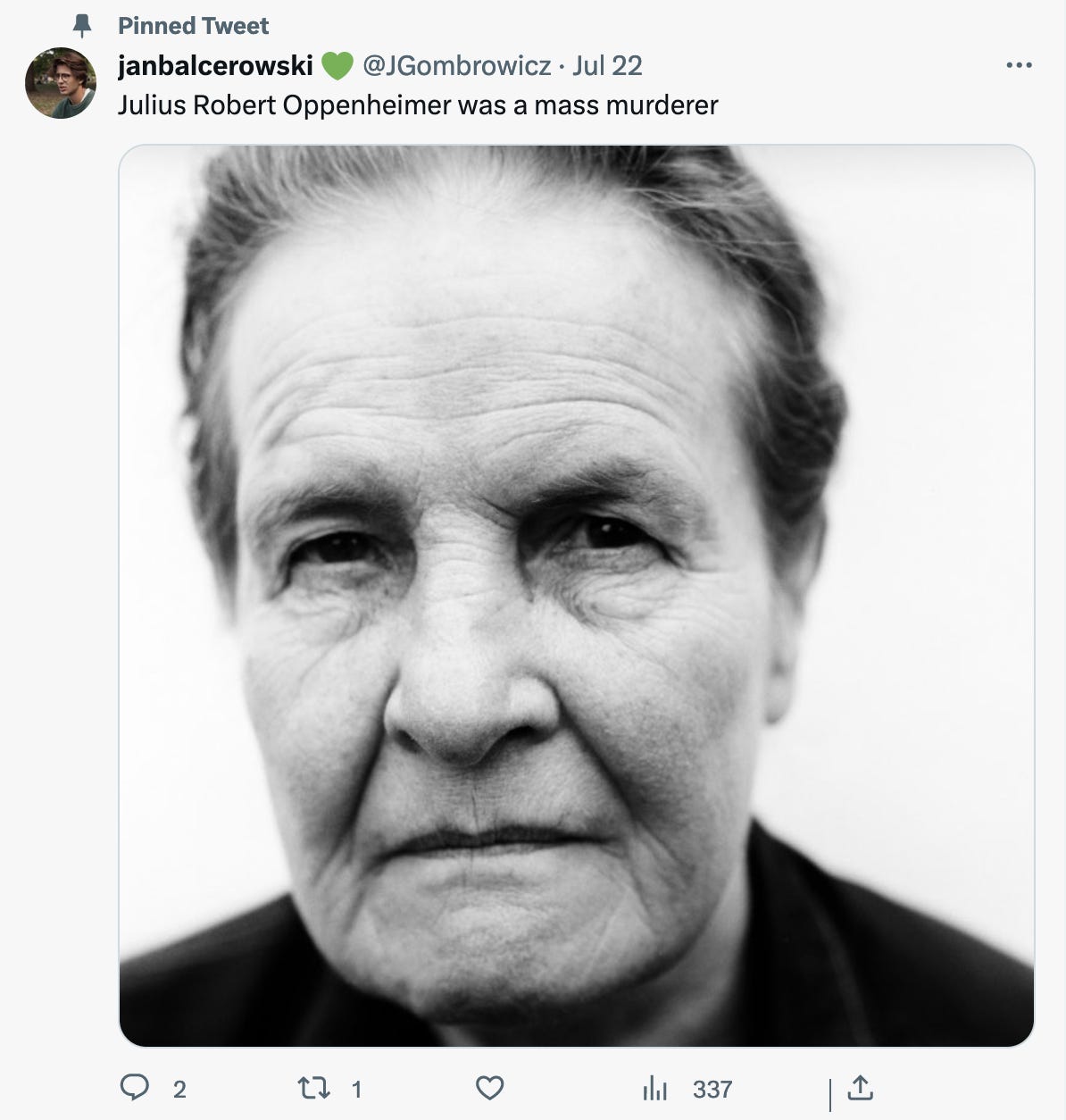
There is a lot to unpack and I might try in a dedicated post. Stay tuned.
In the Meantime
I had a lovely and pretty insane couple of weeks now. In short:
N. came, we travelled across some parts of Poland and Hiked
We watched the True Detective (WOAH)
We went to the movies and Wieliczka Salt Mine (To be continued)
I had the PERFECT birthday party, organised by K.
I failed my driver’s licence (again) and need to commit myself to getting it done somehow (it’s hard [impossible] to sign in earlier than September)
I had a little family drama around me not calling my elders (they did not call me to say hi on my birthday either)
Finally, I went hiking again, this time with K - we are planning a book about it
Today I saw Oppenheimer and Barbie.
I am kind of done (I will devote even less time now) with my little bond project, you can see my workings here and let me know if you have feedback here.
I planned this to be published earlier on Tuesday but:
K. and I went to visit the scout camp, our car broke and we got stranded in the woods.
Update: I am self-diagnosed with a severe case of a summer melancholia [that’s still happening]
Okay, I am done.
In the News
Donald Tusk started a little xenophobic campaign the other day. Maybe to keep up with PiS or to chase the spectre of Konfederacja. I wouldn’t know. Either way, his brilliant attack on poor migrants from Islamic countries has led the government to roll back its promises of a simplified procedure to get a working visa. What did the hard working people from Saudi Arabia, Bangladesh or Pakistan do to Mr. Chairman? I don’t know. I am sure that he, an enlightened liberal has good reasons to hate them and work so hard to deny them entry to Europe.
Maybe I am annoying. Maybe I am just jealous. The admiration that some of the Polish voters have for this man is truly baffling. I guess that all his misdeeds are now forgotten, because whatever you say could be just read as the other one of many Law and Justice lies they came up with in the past few years.
But I care less about the past than I used to. Mostly because I am too lazy to build these long story-based arguments. I care about integrity. Career politicians lack that at the core of their personalities. I am tired of people just saying they are doing this and that ‘for Poland‘. In reality, after all, they are doing it for themselves, their own power.
But Jan, everyone does that. Sure. It doesn’t mean I don’t get to be tired of it. Right? The worst part about some of the conservatives is that some of them actually believe in the things they are saying - the boogeymen of the decay of traditional values or the LGBT ideology. The scariest thing about centrist politicians is that they do not believe in anything.
Politics should be the only means to an end, not an end itself
[The coverage of the election campaign will return]
On the Shelf
Derek Parfit, William Stoner, J. Robert Oppenheimer. They haven’t got much in common. One of them is a fictional character. In a way, they all are fictional characters.
Of academics and rules
Derek Parfit is the protagonist of D. Edmonds’ Biography, Parfit. Derek Parfit is one of the most cited ethicists of the twentieth century. He has been influential in so many fields including personal identity, environmental ethics and the formation of the utilitarian Effective Altruism movement. At the same time, he was the kind of public figure I learned to hate. In his lifetime he published two major works, despite overpromising to his publisher. He was too busy addressing what matters that he couldn’t be bothered to complete his PhD and to receive it. He did not even try to perform a Wittgenstein manoeuvre, that would at least get him the title. On more than one occasion he expressed his belief that rules should not apply to him.
These vices are of course not a reason to discard his moral reasoning, but it is also in no way of interest to this piece. Derek Parfit, for me, is a poor example of the genius I find inspiring. His raving popularity and privilege he enjoyed from early on, which Edmonds leaves out, was just annoying and made me actually jealous, rather than anything else. I know boys (they are all boys) like Derek Parfit, maybe not half as brilliant, but so sure of their exceptionalism that they will bend reality and truth to get their way. (I used to be one.)
But this is a character that plagues academia. In John William’s Stoner (thanks, G. for recommending) tormented English professor from Mizzou is tortured by his superiors because he insists on applying equal rules for everyone. Including one (kind of brilliant) student with a powerful protector. Stoner sees his life ruined but remains a teacher, devoted to his passion. It’s all because for him academia is not a career path or a fringe lifestyle. It isn’t the terribly serious adventure it was for Oxford philosopher of the 1960s. The university is a refuge:
It's for us that the University exists, for the dispossessed of the world; not for the students, not for the selfless pursuit of knowledge, not for any of the reasons that you hear. We give out the reasons, and we let a few of the ordinary ones in, those that would do in the world; but that's just protective coloration.
Is William Stoner a tragic figure? Probably. Especially if we believe that mediocrity is a failure. The definition of what being mediocre or average is might be already a challenging one. A life well lived is not to be measured by the objective values of success but rather by the ability to be happy. In order to escape some weird Parfitian math I precisely said ability to be happy, rather than actualised total happiness.
I am now entering the dangerous areas of the pretentiousness meter installed in my word processor. I will continue to tread lightly and just stick to truisms. Okay?
Some people are blessed. In a secular way, of course. They are able to see good things every day. Not in everything, such people are too weird for me to call them blessed. Nonetheless, some people see beauty in daily events, even if it’s not breathtaking, they are happy even if they don’t fulfil 150% of what they planned. Was William Stoner such a person? Probably. It must have been that ability to see the beauty in the Old English verses and early modern plays that kept him going.
Of ethics
I love biopics. I do. Especially the tormented genius ones. In some (faraway) possible world, I am now filming a great TV show about Wittgenstein and (season two) GEM Anscombe. [See endnote for more detail. Especially G. because you hate Anscombe]. I just find them super thrilling. Oppenheimer is really good because it did not make me start reading up on quantum physics.
[Mild spoilers ahead]
The greatness of the movie comes from its honesty in dealing with the moral ambiguity of its protagonist. Unlike Edmonds Nolan never met Oppenheimer. There are probably fewer people who knew him and loved him than the legions of Parfit disciples around the world. J. Robert Oppenheimer might have been a mass murderer and he definitely was not a modern-day saint. Was he a genius physicist? The movie does not show that either. It is not a hagiography, but a study of a decision. The decision to contribute to massive scale harm and the cost it brings.
The causal conclusion on that contribution is saddening. Oppenheimer had no actual choice in whether the harm perpetrated by the device will actualise. The movie makes a point of demonstrating that the atomic bomb was a logical conclusion from the moment the team at the Free University in Berlin discovered fission. Additionally, he is later absolved by Harry S. Truman: “Blood on his hands, dammit, he hasn’t half as much blood on his hands as I have, you just don’t go around bellyaching about it.”
The jury is still out on the question from the tweet in the beginning, but it will not be as easy as I might have thought.
Brigning it all together
There isn’t much that actually connects these three men. Except for of course the academia. Two of them were successful, even beyond their own field and probably both, actually more successful than their merits would allow. The third serves as a cautionary tale for some - just because you will work hard will not make you into Parfitt or Oppenheimer. But maybe being Stoner is not the hell it might seem from our ivory towers of Russel Group or Oxbridge universities.
Up Next
Original: Phew, that was meant to be shorter. I will be back on Monday! You could’ve met me in Buczkowice, and came stay a night in the Silesian mountains (most of those who declared did not.)… Come on!
New: Phew, it's been a while. Booooks will return with more Oppenheimer, some stuff on risk and accident MORE John Williams. I am now far away on the Atlantic Coast (Portugal) but you can catch me in Prague or Vienna in the coming weeks.
Endnote:
The final climax of Season One would be the publishing of the Tractatus. Naturally, the final scene would be:
[A sunny day in Oxford in front of the Blackwells. The camera on the door from the inside. At torso height. Head obscured]
[Doors open, bell rings]
Phillippa Foot (from behind): Elisabeth, where are you going?
Elisabeth Anscombe: Just a minute!
[Door close, Anscombe approaches a shelf. Take on the shelf: reveals the Tractatus. Elisabeth picks it up and opens it at random. Then reads.]
Anscombe [Voiceover]: Identity of an object I express by identity of sign, and not by using a sign for identity. Difference of objects I express by difference of signs. [Tractatus: 5.534]
[Closes book. In the next scene we see Foot]
Foot: What is the matter?
[Take on Anscombe’s face (we see it for the first time)]
Anscombe: I have to go to Cambridge.
[End Credits]